The Reykjavik Marathon is the best known race in Iceland and has been around since 1984 — more than four decades of running through the streets of the capital. Four distances are on offer for all ages: full marathon, half marathon, 10K and a “fun run” for all ages – which can be either 1.7 or 3 km, and filled with entertainment along the route. There’s also a 10K fun walk for those who’d rather take it at walking pace. Online registration for 2026 is open — popular distances can sell out as race day approaches, so it’s worth registering early.
The race, which is called Reykjavíkurmaraþon Íslandsbanka in Icelandic, takes place on Saturday 22 August 2026, as usual on the same day as the biggest annual festival in the city, the Reykjavik Culture Night (is. Menningarnótt). It is always scheduled on the anniversary of Reykjavik City (18 August) or the first Saturday after that date.
- See also: Running in Iceland: A Simple Guide
The race has a new start and finish this year. All distances now start at Háskóli Íslands (the University of Iceland) and finish on Geirsgata, by the Kolaportið flea market near the old harbour. This applies to every distance, including the Fun Run. Detailed 2026 route maps are still being finalised; check the official site closer to race day.
Planning further ahead? Based on the event’s usual timing (the first Saturday on or after Reykjavík’s 18 August birthday), the race is expected to be on Saturday 21 August 2027 and Saturday 19 August 2028. Confirm on the official site once announced.
Race-day schedule
- 07:00 – Information centre and bag storage open
- 08:15 – Marathon & half marathon — competition start
- 08:45 – Marathon & half marathon — general start
- 09:30 – 10K — competition start
- 10:00 – 10K general start + 10K fun walk
- 11:30 – Fun Run warm-up begins
- 12:00 – Fun Run start
Timing stops at 15:30. Runners who reach the finish area after that won’t get a recorded time.
One thing worth underlining: make sure you know which start group you’re in and set off with it. Starting with the wrong group means disqualification and no recorded time.
Tickets: competition vs general
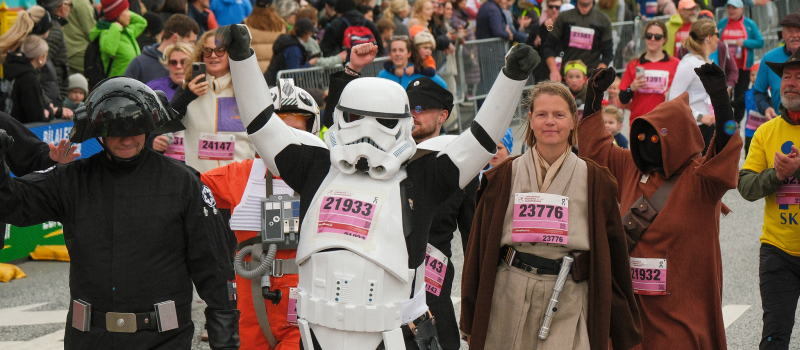
The marathon, half marathon and 10K are each sold as either a competition ticket or a general ticket:
- Competition ticket — chip-timed, results certified by FRÍ (the Icelandic Athletic Federation) and usable to qualify for other races abroad.
- General ticket — run the same course without competing for prizes; results are not certified.
The two groups set off 30 minutes apart (see the schedule above). The Fun Run has no such split. Entry fees rise the closer it gets to race day; the current price list is on the official site.
Fun Run
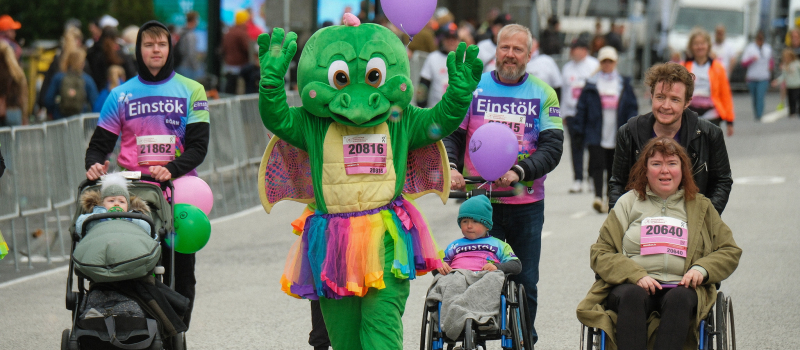
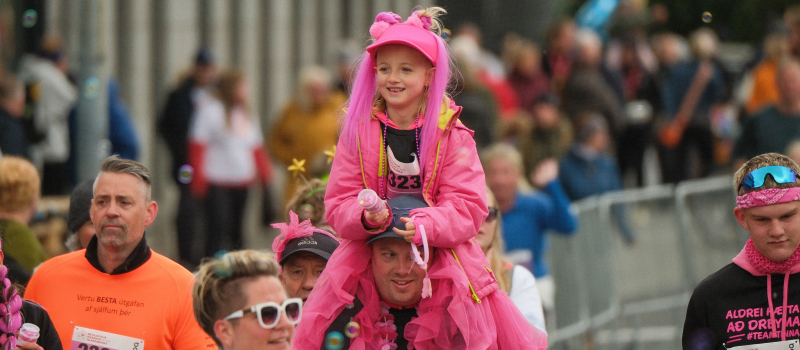
The Fun Run starts at 12:00, with a warm-up from 11:30, and offers two distances: 3 km or 1.7 km. It’s a family event with a relaxed, festive atmosphere — costumes are welcome, and in past years there has been live music and appearances from the main sponsor Íslandsbanki’s mascot. There’s no timing and no age limit; parents often run it with their children. Like every other distance, it starts at Háskóli Íslands and finishes on Geirsgata.
10K Race
The 10K has long been the most popular distance, with several thousand runners taking part (around 7,000 in recent years). It’s not recommended for children under 12. In recent years the time limit has been 4 hours 30 minutes — and remember the 15:30 timing cutoff applies regardless.
Start times: competition 09:30, general 10:00. The 10K fun walk also sets off at 10:00 — same distance, walking pace, no pressure.
The 2026 course starts at Háskóli Íslands and finishes on Geirsgata. Previous editions ran west out of the centre through Vesturbær and along the Seltjarnarnes coastline before returning to the old harbour area, but the route has been redrawn for 2026 — check the official map before race day.
Half Marathon
Just 68 runners took part in the first Reykjavík half marathon; in recent years the field has been around 3,000. Participants must be at least 15. In recent years the time limit has been 6 hours 30 minutes, with the 15:30 timing cutoff applying regardless.
Start times: competition 08:15, general 08:45.
The half marathon (21.1K) starts at Háskóli Íslands and finishes on Geirsgata. Earlier editions shared much of the 10K route before heading along Sæbraut toward the Sundahöfn harbour area; the 2026 course is new, so check the official map.
Full Reykjavik Marathon
The marathon (42.2K) starts alongside the half marathon: competition at 08:15, general at 08:45. Participants must be 18 or older, and in recent years the time limit has been 6 hours 30 minutes.
Like every distance, it starts at Háskóli Íslands and finishes on Geirsgata. Around 1,500 runners register each year. Earlier courses looped through much of the city — Ægisíða, Grandi, Sæbraut, Laugardalur, Elliðaárdalur, Bryggjuhverfi, Fossvogur and Þingholt — with roughly 174 m of total elevation, but the 2026 route and its elevation profile are new. Check the official map.
Registration
Online registration is open until race day, handled through the race’s registration platform, and you can also register in person at the EXPO on the Thursday and Friday before the race. Entry fees increase as race day nears, and popular distances can sell out — so earlier is both cheaper and safer. Everyone must collect their race pack at the EXPO; packs are not posted out in advance.
Your entry includes a bib with a built-in timing chip and a finisher’s medal; competition-ticket runners also compete for prizes and prize money. On-course and finish-line refreshments are provided, and in past years entry has included admission to one of the city’s geothermal pools — confirm current inclusions when you register.
Register for the Reykjavík Marathon 2026 on the official site.
The Story
Ancient origins – War and Royalty
The modern tradition of a “Marathon” run takes its name from the Battle of Marathon in 490 BC, and the myth goes like this: an Athenian soldier, Pheidippides, ran the roughly 40 km from the battlefield at Marathon to Athens to announce that the heavily outnumbered Greeks had somehow beaten back the Persians. He gasped out the news — “Rejoice, we have won” — and promptly dropped dead from the effort. It’s a great story. It gave the race its name, and it’s why the distance is roughly what it is.
Fun fact, though: there’s basically no evidence for it. Our earliest source, Herodotus, was writing within living memory of the battle — and he tells a different, and frankly more impressive, story. In his version, a professional day-runner named Pheidippides was sent from Athens to Sparta to beg for help before the fighting: roughly 240 km in two days, and then he ran back. He arrived to find the Spartans mid-way through a nine-day religious festival during which warfare was forbidden. (In fact there is another athletic event, called The Spartathlon, a 246 km race from Athens to Sparta, that is based on this version of history, celebrated annually since 1983!)
Herodotus never mentions any run from Marathon to Athens at all — and his silence on such a dramatic incident is exactly why historians doubt it ever happened. The death-run first shows up in Plutarch some 500 years later, who names the messenger as Thersippus, not Pheidippides; only Lucian, later still, assembles the version we tell today, which one scholar has called a likely romantic invention. Robert Browning’s 1879 poem welded the two together, and that’s the composite that stuck.
The distance of 42.195 KM (26.22 Miles), is a similar story — it sounds ancient and precise, and it’s neither. The modern race exists because a French philologist, Michel Bréal, proposed it for the first modern Olympics in Athens in 1896, inspired by Browning’s poem and backed by Pierre de Coubertin. That first race was about 40 km. The oddly exact 42.195 km came later, and by accident: it’s simply the length of the 1908 London Olympic course from Windsor Castle to the White City Stadium, which the IAAF locked in as the universal standard in 1921. Before that it even wandered — 40.2 km in Stockholm in 1912, 42.75 km in Antwerp in 1920.
There’s a charming story about why the London course was that exact length: supposedly the start was set on the lawn beneath Windsor Castle so the royal children could watch, and the finish was extended so Queen Alexandra had a clear view from the royal box — leaving the race a few hundred yards longer than planned. It’s repeated everywhere, but historians treat it with suspicion; the more prosaic explanation is that the route and finish were adjusted for practical reasons like stadium entrances and rough ground. Either way, the outcome was the same: the distance Reykjavík’s runners cover has nothing to do with Greece, and quite possibly nothing to do with royalty either — it’s an Edwardian British accident that happened to stick.
Modern History
The idea of the Reykjavik Marathon came from two entrepreneurs back in 1983, working at a travel agency, they landed on the idea of an international road race in Reykjavík, and the first one was held in 1984. Interest in distance running had been building in Iceland through the early 1980s — in the summer of 1980, a marathon was run from Kambabrún down into Reykjavík. But the push for a proper city race came just as much from the tourism industry, where operators were hunting for ways to draw new kinds of visitors to the capital.
The tourism plan worked immediately. Of the 214 people registered that first year, 135 were Icelanders and 79 came from abroad — a race dreamed up partly to show visitors our city filled more than a third of its debut field with them.
Four decades on, the scale is rather different, with up to 16.000 people taking part across all distances, with thousands of runners still arriving from around the world.
The race has been organised since 2003 by Íþróttabandalag Reykjavíkur (ÍBR), the association of the city’s sports clubs, and it takes more than 500 volunteers to stage — most of them drawn from those same clubs. The money stays close to home, too: profits are split in two, with half reinvested in the running events themselves and half going to Reykjavík’s sports clubs through ÍBR’s support fund. Íslandsbanki bank has been the title sponsor since 2006, which is why the race is Reykjavíkurmaraþon Íslandsbanka in Icelandic.