Reykjavík Pride — Hinsegin dagar in Icelandic — returns in 2026, running from Tuesday 4 August to Sunday 9 August. For the better part of a week the capital fills with drag shows, concerts, talks, workshops and family events, building up to the Pride Parade and an outdoor concert on Saturday 8 August. It is one of the biggest events on Iceland’s calendar, and one of the friendliest weeks of the year to be in the city.
Everything below covers the 2026 edition. Because the organisers add to the programme right up to the festival, it is worth double-checking event details on the official website before you go.

When is Reykjavík Pride 2026?
- Festival dates: Tuesday 4 – Sunday 9 August 2026
- Opening: Tuesday 4 August (opening event at the Pride Centre midday, opening ceremony that evening)
- Pride Parade: Saturday 8 August, 2:00 PM
- Outdoor concert: Saturday 8 August, from around 3:00 PM, in Hljómskálagarður park
- Official closing party: Saturday 8 August
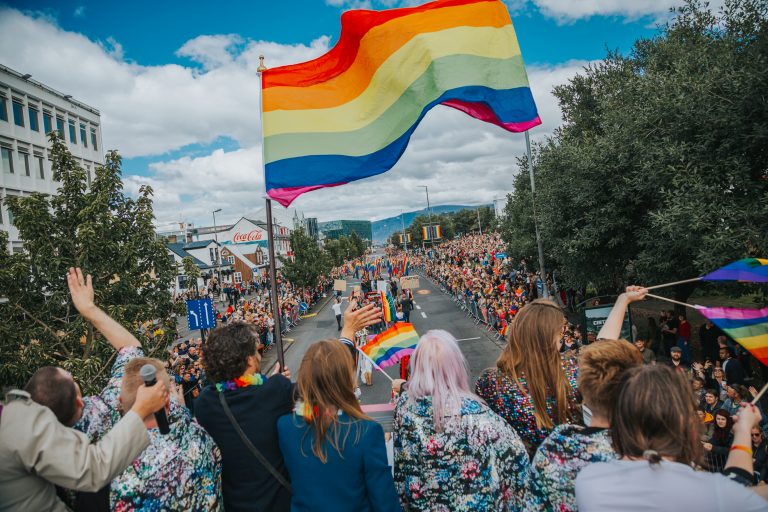
The Reykjavík Pride Parade 2026 – the “March of Joy”
The parade is the heart of the festival. From the beginning, the organizers chose a very positive framing for the parade: Gleðigangan, which translates to the “March of Joy.” When the first parade was organised in 2000, that name was chosen to set it apart from the smaller “liberation marches” of 1993 and 1994. One of the organisers, Heimir Már Pétursson, has described the aim as creating the very opposite of a demonstration — a celebration, with no note of protest or struggle.
Highlights of the 2026 programme
- Room For EVERYONE! is an educational stand-up comedy show about the history of queer flags, explaining their importance as a counterweight to shame. On August 3rd.
- Read more
Opening of Reykjavík Pride 2026
- The festival officially kicks off outside the Pride Centre on Tuesday 4 August at noon — a low-key, come-as-you-are start to the week before things ramp up.
- Read more about the opening cereemony of Reykjavik Pride 2026
Rainbow Family Festival
- Wednesday 5 August, 3:30–5:00 PM, at Elliðaárstöðin (Rafstöðvavegi 6–14). An afternoon built for kids and families, with the playful, all-welcome energy Pride does best.
Rainbow Conference
- Thursday 6 August, 9:00 AM–5:00 PM, spread across the Pride Centre and Reykjavík City Hall. A full day of talks and workshops on the issues facing the LGBTQ+ community in Iceland and beyond — this is the festival’s more substantive side, for anyone who wants Pride with some depth alongside the party.
Proudly Setting Sail — the Reykjavík Pride Queer Cruise
- Friday 7 August, departing 6:00 PM from the Old Harbour (Ægisgarður). One of the festival’s marquee tickets (marked “Popular” on the official programme) — a boat out into Faxaflói Bay with music and views back over the city. 20+.
Drag Brunch Pride
- Saturday 8 August, 11:30 AM–1:30 PM, at Austurbæjarbíó. A leisurely, glittery start to the festival’s biggest day, before the parade route fills up outside. 18+.
- Read more about the Drag Brunch
The Reykjavík Pride Parade & Outdoor Concert
- Saturday 8 August — parade at 2:00 PM from Hallgrímskirkja to Hljómskálagarður, concert following from 3:00 PM. The heart of the week: the city turns out en masse, and the concert closes it out with music and speeches in the park.
The Official Closing Party
- Saturday 8 August, 10:00 PM–3:00 AM, back at the Pride Centre. The week’s last hurrah. 20+.
Many events are free; some ticketed or venue events carry age limits, so check the individual listings.
A short history of Reykjavík Pride
As well as being a big draw for visitors, the festival is supported and embraced by the city and locals. Of course it’s not always been this way. Here’s the cliff notes to the journey so far…
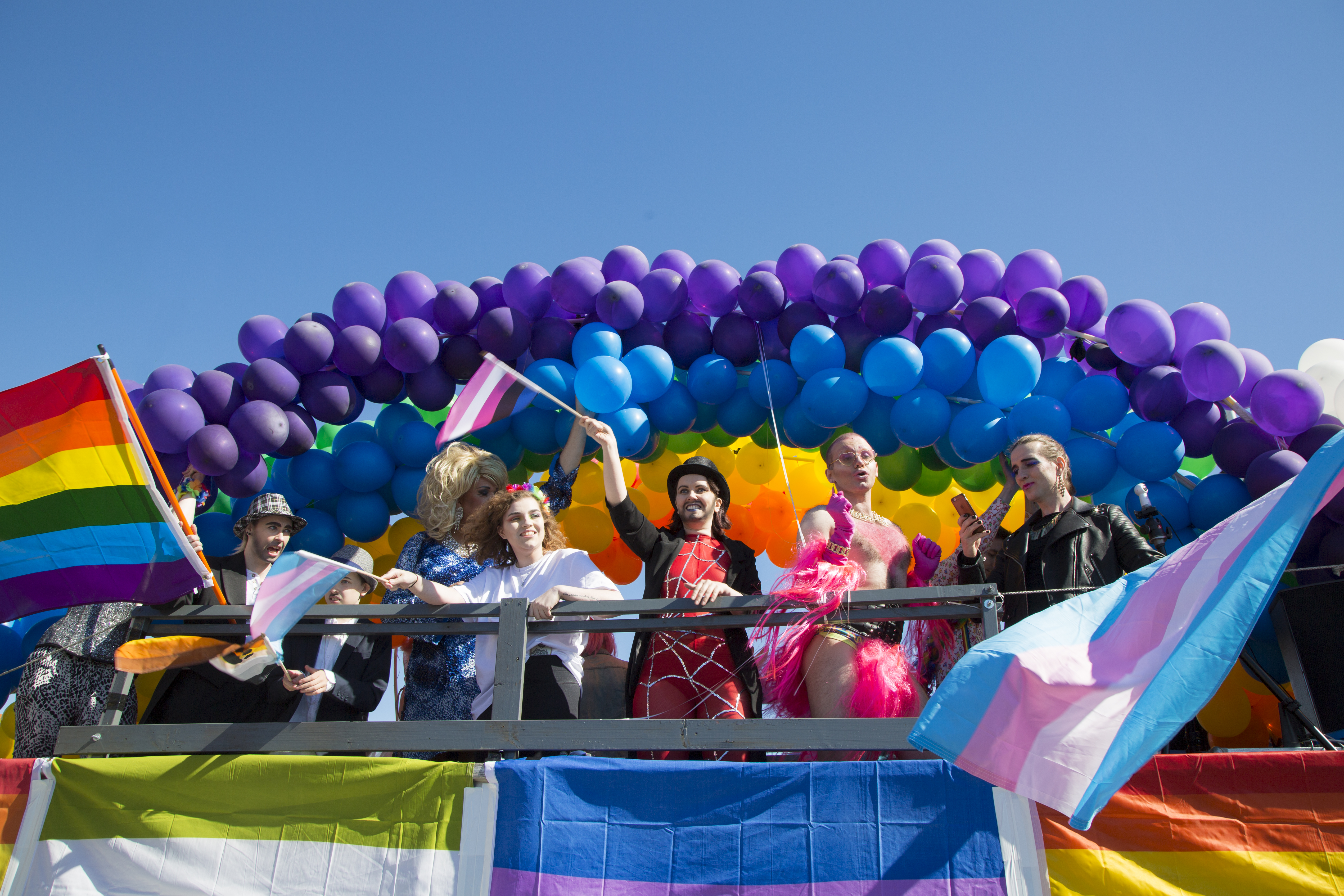
Reykjavík Pride has been an annual event since 1999, though the first Pride Parade was not held until August 2000. Its roots reach back to 1993, when gays and lesbians first gathered in central Reykjavík to call for equal rights — a gathering repeated in 1994. What began as a small event of around fifteen hundred onlookers has grown into a near week-long celebration that now draws over 100,000 people, striking for a country of under 400,000. The organisers affectionately call it “the world’s biggest small Pride.”
Incremental change and Hörður’s exile
That growth followed decades of slow, hard-won change. Same-sex activity was decriminalised in Iceland back in 1940, but public visibility came much later: In 1975, Hörður Torfason, an up-and-coming singer, scandalised the country when he admitted to being homosexual in an interview in magazine Samúel. His coming out was groundbreaking for the LGBTQI+ community, but society’s reaction was less than stellar. Faced with hostile reactions and threats, Hörður eventually left the country for a few years while the commotion died down.
Every victory was hard earned
Much like Hörður Torfa was the “first (openly) gay man” in Iceland, Anna Kristjánsdóttir was the “first (openly) trans person” in Iceland. Anna didn’t get the support she needed from the Icelandic medical system, so she went abroad to finish the transition and came out as trans while she lived in Sweden in the 90s. Amazingly, Anna was the only out trans person in Iceland and faced an uphill struggle to gain acceptance.

Not there but it’s getting better
Ever since 1940, the year ‘gay sex’ stopped being a punishable offence in Iceland, there has been excruciatingly slow but steady progress towards acceptance. Rigid gender roles and strict heteronormativity have slowly made way for a more liberal attitude towards sex, love, and life from the general population.
There have been milestones…
The LGBTQI+ community in Iceland have today have many legal rights that seemed unthinkable just a few decades ago. Confirmed cohabitation, a substitute for marriage with some of the legal rights, came first, followed by the right to adopt, and finally, in 2010, individuals of the same sex could get married, a ruling that’s given birth to a thriving alopement and wedding industry.
And pioneers…
Jóhanna Sigurðardóttir has been a prominent politician in Iceland for decades. In 2009, she made international news when she not only became the first female prime minister of Iceland, but also the first openly lesbian prime minister in the world. Her wife, Jónína, is a writer and in 2013, she published their love story after having to keep their private life private for decades.
But things aren’t perfect yet
When Hörður Torfa returned to Iceland after his informal exile, he and some other enterprising people founded Samtökin ’78 (that simply translates to The ‘78 Organisation), Iceland’s most prominent LGBTI+ rights association. Samtökin ‘78 have spent decades educating the public in Iceland and fighting for the rights of their members. Unfortunately, there’s still a need for Samtökin – the fight for equality isn’t over yet.

Planning your visit
Pride is free and centred on downtown Reykjavík (the 101 postcode), so almost everything is within walking distance. If you are staying further out, the Strætó city buses cover the capital area. Downtown accommodation books up fast in early August, so reserve ahead.
If you want to combine your pride celebration with taking in the sights, we have a selection of LGTBQI+ activities available on our website. The Reykjavik Pride festival is also very close to a total solar eclipse visible from Iceland on August 12th, and we offer a variety of solar eclipse tours if you’re interested in that.
Pride also kicks off a busy month in the city: Culture Night (Menningarnótt) and the Reykjavík Marathon both follow later in August.
For further information head to: https://hinsegindagar.is/en/
Check out the full programme at www.reykjavikpride.is